Physics-Informed Ellipsoidal Coordinate Encoding Implicit Neural Representation for high-resolution volumetric wide-field microscopy
Preprint in bioRxiv, 2024
Abstract
Wide-field fluorescence microscopy with axial scanning enables volumetric imaging of cellular and intracellular activities but is fundamentally limited by the “missing cone” in the optical transfer function (OTF), leading to poor axial resolution and weak optical sectioning. Existing deconvolution methods provide only partial correction, while recent deep learning approaches often rely on paired training data or strong sample priors. Here, we propose Physics-Informed Ellipsoidal Coordinate Encoding Implicit Neural Representation (PIECE-INR) to overcome challenges like background interference and resolution degradation in wide-field volumetric microscopy. By introducing an ellipsoidal coordinate encoding strategy and embedding physical priors into a self-supervised implicit neural network, PIECE-INR enables high-fidelity 3D reconstruction without ground-truth training data. PIECE-INR supports block-wise large-scale imaging by leveraging localized physical information. We demonstrate its state-of-the-art performance on live HeLa cells, large-volume C. elegans embryos, and mitochondrial dynamics, offering a robust and scalable solution for wide-field volumetric microscopy.
Methods
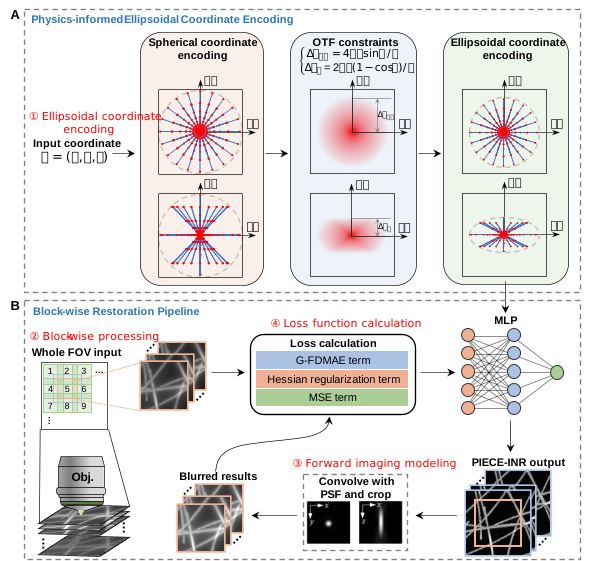
Principle of physics-informed encoding and pipeline of PIECE-INR
Recommended citation: Zhou, You, et al. "Physics-Informed Ellipsoidal Coordinate Encoding Implicit Neural Representation for high-resolution volumetric wide-field microscopy." bioRxiv (2024): 2024-10.
Download Paper | Code Repository